Fake Review Bounty Hunter: fraud signals in Yelp reviews
Fraud detection with NLP and graph analytics
- Problem
- A business with high star ratings can have reviews whose sentiment says otherwise.
- What was done
- Scored reviews with DistilBERT and mapped reviewer links in Neo4j, with PySpark and PostgreSQL behind it.
- What changed
- On 5,000 Yelp reviews, it flagged 15% of businesses whose high ratings did not match their review sentiment.
- Businesses flagged, ratings vs sentiment
- 15%
- Yelp reviews in the sample
- 5,000
Figures
Figure
Fit. Plus and minus keys zoom, arrow keys pan
Problem
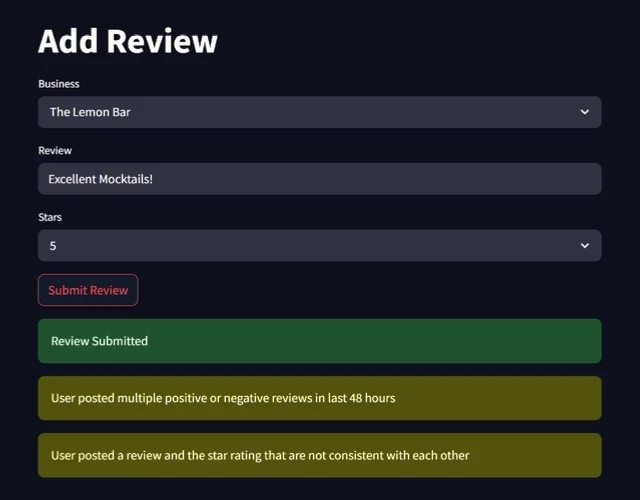
Star ratings and review text can disagree. A business whose high ratings do not match the sentiment of its reviews is a fraud signal worth a closer look.
Approach
DistilBERT scores the sentiment of each review. A Neo4j graph maps the links between reviewers. PySpark and PostgreSQL handle the data. The sample was 5,000 reviews drawn from a 6M-review Yelp dataset.
Highlights
- Scored reviews with DistilBERT and mapped reviewer links in Neo4j.
- Sampled 5,000 reviews from a 6M-review Yelp dataset.
- Flagged 15% of businesses whose high ratings did not match review sentiment.